Visual Semantic SEO Stop writing
more. Start
meaning more.
Those 25 bullet points aren't 25 rules. They're a single shift, broken into consequences. Hold one sentence in your head and every tip becomes obvious.
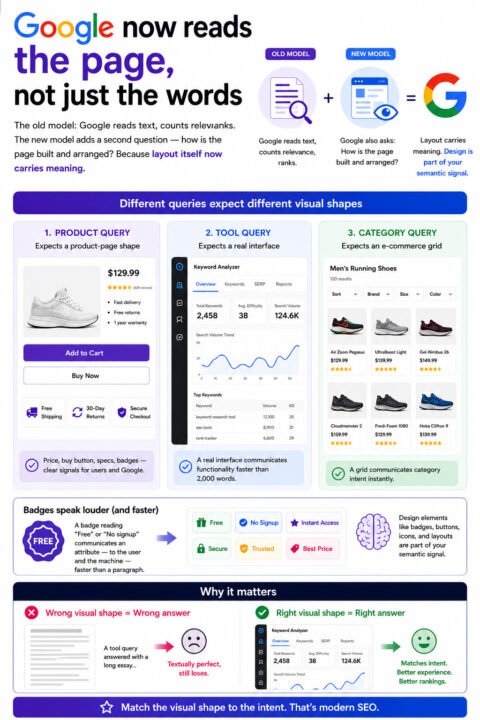
Google now reads the page, not just the words
The old model: Google reads text, counts relevance, ranks. The new model adds a second question — how is the page built and arranged? Because layout itself now carries meaning.
- A product query expects a product-page shape — price, buy button, specs.
- A tool query expects a real interface, not a 2,000-word essay about the tool.
- A category query expects an e-commerce grid.
So a badge reading Free or No signup communicates an attribute — to the user and the machine — faster than a paragraph does. The design is part of your semantic signal.
Fewer words — said earlier
The most counter-intuitive point, and the reason it's repeated: put your most important entities and attributes in the first few percent of the page. File extensions, product names, service types, “free / online / fast.” The opening block is where Google forms its strongest first impression.
Then stop padding. Extra sentences don't add authority — they dilute keyword concentration and lower relevance density. A short page that fully satisfies intent beats a long article that buries the answer.
There's a sharper reason too: fewer tokens = lower AI-detection confidence. Thin, generic prose is easy to flag; tight, entity-dense, visually-supported pages read as intentional human work. “Let visuals replace paragraphs” does double duty — better relevance and fewer AI fingerprints.
Give Google time to build confidence
Ranking isn't instant trust. When a page gains traction, Google is still deciding how much to believe it — which is why rankings swing wildly before settling.
The common mistake: seeing the fluctuation, panicking, and editing again. Every edit resets the clock. The discipline is simple — once a page gains momentum, leave it alone and let confidence accumulate.
Publish like a real site, not a factory
Two things get penalized: scaled content abuse (dumping thousands of pages at once) and mechanical, unnatural publishing. The fix is patience plus camouflage.
- Age a new site or subfolder (~3 months) before scaling. Build real user signals first.
- Randomize velocity. Not “10 pages every day” — that's a machine signature. Editorial output is lumpy, so make yours lumpy too.
The principle: natural-looking growth earns trust; industrial-looking growth earns scrutiny.
Finish the topic — don't expand forever
A topical map isn't a treadmill. The goal is completeness, not infinity.
- Cover your entire topic in roughly 7–8 months, then close the network — no gaping holes.
- Against competitors: crawl their sitemaps, merge every topic into one unified map, and aim for ~20–30% more coverage — not 2× or 3×.
Just enough to become the better replacement, not a bloated one.
Map each query to the right unit
Not every keyword deserves its own URL. Every query deserves one of three things:
- a page — a distinct intent,
- a heading — a sub-intent inside a page,
- a section or sentence — a detail.
Mis-sizing this is how sites end up with hundreds of thin pages that should have been paragraphs. Right-sizing keeps authority concentrated.
Content briefs need a “Component” column
Traditional briefs only specify headings. Add a column for what visual or interactive element renders each section:
This is the layout idea made operational — you brief meaning and shape, not just text, so the right visual answer gets built from the start.
Build tools, not just articles
Blog posts are the cheapest, most-copied format. Tools are defensible and match tool-intent queries directly. For a law firm, instead of another guide: a compensation calculator, a case evaluator, an accident-image analyzer.
Calculators, checkers, generators, estimators, converters — each is a page that does something, earns links naturally, and resists replication by AI text. The tool itself becomes the ranking asset.
Read your AI Overview data as its own channel
Treat AI answers as a separate surface with its own analytics. Compare:
- AI Overview impressions vs. normal search impressions,
- crawl frequency and which Googlebot user agents hit which folders,
- which content formats actually appear in AI answers.
You're reverse-engineering what the AI layer prefers — which pages, folders, and structures — then producing more of that.
Links are becoming mentions and attributes
A link used to be mostly PageRank. Now it also carries entity meaning. An external mention — “the largest agency,” “best lawyer in Texas,” “highest-compensation firm” — doesn't just pass authority; it assigns an attribute to your entity.
Repeated, consistent mentions across the web are how the AI layer decides what you are. Off-site work becomes about engineering consensus, not counting links.
Take your topical map off your own site
- External topical maps — publish supporting articles on other relevant sites, not only your domain.
- Exact-match supporting domains where appropriate — truck-accident guides, an eSIM-Africa site, a lawyer directory — reinforcing authority from the outside.
The web, not just your domain, is now your topical footprint.
Repurpose everything, everywhere
Every asset becomes a blog post, Reddit thread, video, podcast, social post, audio clip, ebook. The goal isn't only traffic — it's surface area. The more places the same meaning appears, the more corroborated the entity signal becomes.
Become multiple entity types
Authority is easier to establish when you exist as many recognized entities: author, podcast host, speaker, show creator, course creator. Register those identities where machines already trust them —
Each profile is an external node confirming: this is a real, notable entity in this field.
Social as a funnel
Simple and mechanical: 3 reels a day, the first 3 seconds must hook, simplify the language, one strong hook, CTA in the comments, drive into your funnel. Not a ranking tactic — it's surface area and audience capture feeding everything above.
Two writing modes, mixed on purpose
Factual — a rigid structure: Definition → Predicate → Attribute. “X is…”, “X means…”, “X helps…”. Machine-friendly, retrieval-ready.
Opinionated — natural, personal, unstructured. Best for reviews and UGC.
The key move: mix both on one page, plus casual Q&A and structured data. Different retrieval systems — classic search, AI Overview, snippets, review panels — grab different patterns. A page carrying all of them gets pulled into more places.
Stop competing on word count. Compete on meaning — through layout, dense early entities, complete topical coverage, real tools, and outside consensus about who you are.